Chapter
12(a)
The Coronation
 As soon as they entered the
palace, Vasishta, the Royal Preceptor, announced
the date when the Coronation of Rama as the
Emperor of Ayodhya would be celebrated, giving
details of the auspicious attributes of the day
which had persuaded him to choose it for the
great event. He invited also all the pundits and
priests to take part in the ceremonies that the
Vedas had enjoined, to
consummate the coronation. They appreciated the
decision of Vasishta for, they said "a
coronation so celebrated would confer peace and
prosperity on all mankind."
As soon as they entered the
palace, Vasishta, the Royal Preceptor, announced
the date when the Coronation of Rama as the
Emperor of Ayodhya would be celebrated, giving
details of the auspicious attributes of the day
which had persuaded him to choose it for the
great event. He invited also all the pundits and
priests to take part in the ceremonies that the
Vedas had enjoined, to
consummate the coronation. They appreciated the
decision of Vasishta for, they said "a
coronation so celebrated would confer peace and
prosperity on all mankind."
Vasishta called Sumanthra into his presence and
addressed him thus, "Assemble the armed forces -
cavalry, elephantry, chariotry and infantry - at
the city, for the Coronation of Rama is to be
celebrated". Those words filled Sumanthra with
extreme delight; he arranged for the presence of
the army with all its components. The elephants,
horses, and chariots were decorated grandly for
the occasion. They were posted in serried ranks
outside the city gate. The horsemen and the
foot-soldiers wore colourful uniforms and they
stood at attention, ready to march into the city
for the festival. Messengers were sent in all
directions to gather in time the various
auspicious articles necessary for the rituals
that formed part of the celebrations. The entire
city was agog with joy; citizens vied with each
other in decorating their houses and streets.
People felt their two eyes were not enough to
imbibe the charm of the city.
Rama was specially
considerate towards the persons who had
accompanied him from beyond Ayodhya - Sugriva,
Vibhishana, Angada, Nala, Nela and others. He
ordered that proper arrangements be made for
accommodating them and for looking after their
needs. Accordingly, servants from the palace
rushed to perfect the arrangements designed for
the comfort of the guests. Rama called Bharatha and with his own
hands, he combed his hair that had got matted,
since he had not paid any attention to it, for
years. The three brothers personally poured holy
water and attended on Bharatha while he bathed.
Then, Rama received the assent of Vasishta to
disentangle his own matted hair and had his
auspicious bath. The queen mothers meanwhile had
Sita go through her bath also. The mothers
carefully combed her matted hair too, and
dressed her in yellow silk; they made her wear
jewels in plenty. She shone like Goddess
Lakshmi. She moved to where Rama was and took
her seat to the left of her Lord.
The three mothers
[Kausalya, Kaikeyi and Sumitra] experienced the
highest bliss, looking on, while Rama and Sita
were seated together. "Is not this day the
luckiest day for us? This day, our lives have
achieved fulfillment. This day, our dearest wish
has come true. This day, our eyes have had their
purpose realized", they said to themselves. They
lost all consciousness of their bodies or
surroundings, watching Rama and Sita, and taking
them to be the God Narayana and the Divine Consort
of Narayana, Lakshmi. Vasishta the great
Sage was moved by the splendour that shone in
the face of Rama. He was delighted beyond
measure at the divine effulgence of the Rama
Form. 'I achieved today the goal for which I
have been waiting so long', he felt, and he
ruminated on that joy and remained blissful and
silent. He called the servitors and instructed
them to bring the Great Throne and install it in
the Coronation Hall. It was a throne set with
multifarious gemstone which shone like the sun,
with dazzling brilliance.
Rama prostrated
before Vasishta and other sages, and fell at the
feet of the queen-mothers. Then, he prostrated
before the entire assembly of elders and
citizens and ascended the throne, with Sita
following him close. The vast gathering rejoiced
at the unique sight, so full of majesty and
glory. The Rshis, the elders, the
leading citizens and the saintly well-wishers
were filled with gratefulness and joy. The Brahmins recited appropriate
Vedic hymns. The populace shouted Jai Jai, so
loud and so often that the sky threatened to
fall. It was the seventh day of the dark half of
the moon in the month of Vaisakh. Taking the permission
of the assembly and the assent of the Brahmins,
Vasishta wound round the brow of Rama the
insignia of Imperial Authority.
Kausalya, the
mother of Rama, turned her eyes on Rama every
now and then, and felt supremely happy. And,
what can be said of the joy of the brothers Lakshmana, Bharatha and Satrughna! It was beyond words.
They were holding whisks and the umbrella, and
standing behind the throne, as attendants on
Rama. In fact, they were all through the years
doing penance for the culmination they were
enjoying that day! The gods beat drums of
victory in the sky; the celestial musicians sang
hallelujahs, the celestial dancers danced in
joy. Vibhishana, Sugriva, Angada, Hanuman,
Jambavan, Nala, Nela, Dadhimukha, Divida, Mainda
- these heroes bore bows and arrows, scimitars,
spears and stood on both sides of the throne, in
reverential humility.
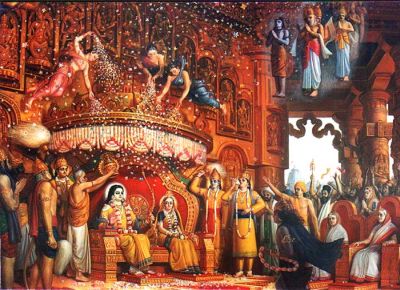
With Sita sitting
on his left, Rama manifested the beauty of a
billion Manmathas (Manmatha - the God of Love)
rolled into one. The gods were fascinated by the
divine charm of the Lord of the Raghu line. Rama
wore silk, interwoven with gold, and he had
pendants on his ears brilliant with precious
gems. He wore ornaments on his ankles and
wrists, which derived beauty from his entrancing
charm. The three worlds exulted at the sublimity
of the event and the personal grandeur of Rama.
Really those who witnessed that scene were the
fortunate ones among the living.
Vibhishana came
forward with a dazzling necklace of gems, which
the Lord of the Sea had offered to Ravana. Sita
accepted it. Its brilliance shone all over the
vast Hall and struck everyone as a unique string
of gems. But, with the necklace in her hand, she
cast a questioning glance at the face of Rama.
Rama knew what was passing in her mind. He said,
"Sita! You can grant it as a gift to anyone
among those here who deserves your grace." Sita
thought just for a second and looked at Hanuman.
Becoming aware of the compassion in that look,
Hanuman approached her in great humility and
stood before Sita with bowed head. The necklace
was given by Sita to Hanuman. Hanuman turned it
around many times in his hand, its dazzle
enrapturing everyone in that vast assembly. He
was struggling to discover its specialness, with
unslaked curiosity. He plucked every gem, put it
between his teeth, and placed it adjacent to his
ear, and with a face indicating disappointment,
he threw the gem away in disgust! All eyes were
watching with increasing amazement this peculiar
behaviour. They were stunned into silence and
inactivity. Until he treated the last gem in the
same cavalier manner, no one dared interrupt or
condemn. They could only protest in whispers
among themselves! "Who is this monkey that
treats the diamond necklace so lovingly and so
compassionately presented to him by Sita?" was
the question on most lips.
Even Vibhishana
was sad that Hanuman had so brazenly insulted
the priceless jewel that he had brought. 'He has
pulled it to pieces and cast the gems aside', he
told himself. Everyone in the Hall surmised the
reason for this strange behaviour in his own
way. At last, one vassal Ruler could not
restrain himself. He rose and gave vent to his
resentment: "Peerless Hero! Why did you break
that necklace of gems into so many bits? Was it
right to do so? Tell us the reason why? Give us
some explanation and remove our doubts."
Sri Hanuman
Chalisa Mantra
Text Mantra
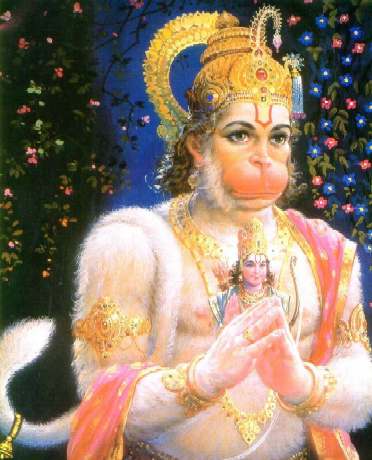
Hanuman listened
to him patiently and replied. "0 King! I
examined each gem in order to discover whether
each had in it the sacred Name of Rama. I could
not find it in any gem. Without that Name of
Rama, they are but stones and pebbles. So, I
cast them on the ground." The ruler was not
silenced by this. He asked, "Hanuman! If it is
your desire that in every article and particle
there should be the name of Rama, are you not
asking for something impossible?" Hanuman
replied, "Of what good, of what profit, is any
thing which has not in it the name of Rama? I
have no need of such". The valiant hero,
Hanuman, dismissed the arguments of the ruler
thus. The ruler, however, continued his
objections. He said, "You would not wear any
thing that has not got in it the name of Rama.
Well. You are wearing your body. You are
carrying it about with you. Prove to us that you
have the name in it". Hanuman laughed aloud; he
said, "I shall prove, see!" He pulled a single
hair from off his forearm and held it very near
the ear of the Ruler. He could hear the name,
Rama, Rama, Rama, uttered by that single hair!
At this, he was overcome with a sense of wonder;
he fell at the feet of Hanuman and prayed for
pardon.
Rama called
Hanuman near Himself and warmly embraced him. He
asked him, "Hanuman! What can I offer you on
this occasion? I have no gift worthy to be given
to you. I am giving you myself as my gift to
you." Then, he offered his body to be clasped by
Hanuman's hands. The assembly was moved into
shouts of Jai at this unique act of grace. They
praised Hanuman and declared that there was no
one to equal him in all the worlds. They praised
the devotion and dedication of Hanuman.
Then, Rama rose
from the throne and moved out into the open,
where vast congregations were awaiting his
appearance. He gave them the Divine Darsan of His charming
majestic Form. They were all thrilled as never
before in the bliss the Darsan conferred. All
who were in the City were provided festive
reception and given lavish food and luxurious
shelter. Rama arranged for the distribution, as
charity, of gold and money, of vehicles,
household utensils and clothing, of houses and
other amenities in plenty. Vibhishana and the
Vanara heroes were wonder-struck at the
magnificent elaborateness of these events. They
stayed on for six months in the Capital, serving
Rama both day and night, in full exultation. The
six months sped away as a single day for them.
They had no memory of their homes, their
families or their kingdoms during all that
period of time.
At last, Rama
called all the companions and comrades, who had
accompanied him, into the Audience Hall and
seated them in appropriate places. Then, he
addressed them in soft, sweet accents, thus;
"Friends! You have all toiled hard on My behalf.
Of course, it is not proper to praise you to
your face. You confronted various difficulties
for My sake, giving up your homes, not worrying
about your wives and children and unconcerned
about your properties and possessions. I have no
friends other than you all. Therefore, I have
special love and compassion towards you. More
than My parents, more than My brothers, more
than My kingdom, more than My subjects, and more
than even My Sita, you are My loved ones. This
is My firm assertion. So, I now require you to
proceed to your homes. Serve Me after installing
Me in your hearts, with faith and devotion. I
shall grant you the fortune of seeing Me, beside
you, behind you, before you and in your homes. I
shall grant you Grace".
They listened to
these words so full of Grace and Love, and they
were so overcome by gratefulness and joy that
they forgot themselves and their surroundings.
They did not allow their eyes to stray away from
the face of Rama; they shed tears of delight
abounding. They could not utter a single word in
reply; the tongue was unable to pronounce any.
Then, under orders from Rama, the servitors
brought large quantities of clothing and jewels.
Lakshmana, Bharatha and Satrughna were requested
to offer them to the members of the party and to
personally help them in wearing them. The
Vanaras and Vibhishana were then assisted by
them in putting them on and they shone with
added charm and brightness. But, the Vanaras
were unaffected by what was done; they stood
unmoved and stiff, looking only at the feet of
Rama, their adored Lord. All bowed their heads
and fell at those lovely feet. And, Rama lifted
them gently and embraced them with great
affection.
Rama told the
departing groups of Vanaras and others,
"Children and friends! I am awarding you the
Sarupya stage of liberation, by which you are
endowed with powers and attainments
approximating to My own. Go back and carry out
the duties devolving upon you with success and
fulfill the responsibilities with which you are
involved. Rule over the lands and peoples
entrusted to your care and enjoy peace and
prosperity". Rama provided them valuable counsel
of various kinds and gave them leave to depart.
Bharatha and Satrughna were struck with
admiration by the devotion that shone in the
hearts of the Vanaras and others. As Rama
commanded, Lakshmana, Bharatha and Satrughna
accompanied the party for some distance until
they reached the outskirts of the City. Even as
they sat in the chariots provided for them, the
Vanaras turned back wistfully and shed tears at
the thought of leaving Rama. The brothers saw
the anguish in their faces and could not bear
the sight. They knew the meaning of those
streams of tears and those sad looks and praised
the spirit of dedication which filled their
hearts. They gave them company until the river
bank and they supervised arrangements for
ferrying them across. Then, the brothers
returned to Ayodhya. Hanuman also returned with
them. He prayed and pleaded with Sugriva, his
ruler, and promised to return after about ten
days for, as he said, "I cannot bear the pang of
separation". Though Sugriva was not very happy,
and in spite of his protests, Hanuman came back
along with Lakshmana and others to where Rama
was.
One day, Rama
proceeded to a garden with his brothers and his
dear Hanuman, in order to spend some time
strolling through it. The place was replete with
flowers and fruits. Rama sat on an elevated
seat, with the brothers on his side. The
brothers were found hesitating to ask some
questions, though they had the desire within
them. They looked at Hanuman and communicated
their feelings to him. They knew that if Hanuman
put those questions, Rama would fain give the
answers. The omnipresent Rama recognized the
situation. "Hanuman! What is it you seek to
know? Ask", he said. Hanuman replied, "O
Protector of the Weak! Bharatha wanted to ask
you a question. But he was stricken by doubt; he
is downcast with a sense of fear". He folded his
palms and fell at the feet of Rama, for having
answered his query so bluntly, and in
thankfulness that he was commanded to speak in
the presence. Rama then spoke thus: "Hanuman!
You know full well My nature. There is no
difference between Me and Bharatha, nothing to
make either feel distinct". When Bharatha heard
these words, he fell at the feet of Rama, and
said, "O Healer of the miseries of those who
surrender to you! Listen. Pardon my errors and
protect me. I have no doubts lurking in my mind.
I have no griefs and no attachments, even in my
dreams. Of course, I owe all this to Your grace
and compassion. You are the treasure-house of
all the virtues. I desire to learn the
distinction between good men and bad."
Rama deigned to
reply. He said, "Brother! The qualities that
mark out the good are endless in number, as the
Vedas and Puranas say. The distinction
that separates the good and the bad are as wide
as that between the sandal tree and the axe.
Note this; even when the axe cuts the sandal
tree, the tree confers on the axe the fragrance
it possesses. The axe is killing it, but the
tree does only good to its executioner. Hence,
the sandal is appreciated by all. The Gods love
to have sandal paste on their foreheads. But,
see what happens to the axe that does harm to
the tree that wishes it well. It is kept in fire
and while red-hot, it is hammered into shape and
sharpness. Wicked persons cause grief to good
men in this manner. But, the good always wish
well and do good to the wicked, whatever harm is
done to them. And, what is their gain? They
certainly attain heaven. That is to say, they
are in constant bliss. The bad persons, on the
other hand, will be constantly struggling in
sorrow and discontent. That is to say, they will
be subject to hellish agony; though they may
appear happy to observers, they will be tortured
inside by the infamy and the hatred they
invoke". (*) (**)
"I shall tell you
the characteristics of good men. Listen. They
are not fascinated by sensual pleasures. They
possess all the best virtues and modes of
behaviour. They will be happy at the happiness
of others; they will be sad when others are sad.
They look upon all with equal affection. They
have no enemies and they are not bothered even
if foes exist. They are endowed with wisdom,
knowledge of the objective world, and a deep
sense of detachment. Their hearts are tender;
they have compassion towards the weak and the
helpless. They adore My feet with purity of
thought, word and deed. They delight in serving
me. They have no concern with fame or infamy,
honour or dishonour. They are always interested
in serving others; they never yield to the urge
of selfishness, even in dreams. Their actions
are transparently simple; their hearts are ever
cool and unruffled. They yearn for opportunities
to renounce; they are every moment soaked in
joy. For them praise and blame are the same.
Brother! Whoever has these characteristics in
him, take it that he is of My own nature. He is
myself, I am himself. Take that to be the
truth".
"Now, I shall tell
you of the qualities of bad men. Listen. You
should avoid their company, by all means. Grief
will descend upon you as a result of that
companionship. Their hearts will be pained at
the prosperity of others. They will delight as
much in scandalizing others, as in welcoming a
fortune. The six foes of bad men - lust, anger,
greed, desire, pride and hatred are fostered by
them and they are ever at their beck and call.
They move about and act according to the
commands of these six. Pity and charity are
absent in their makeup. They pick up quarrels
with others with no reason or on no provocation.
They develop enmity even towards those who do
good to them. Their actions are false; their
utterances are false; their dealings of give and
take are false. Their attitudes are hard; they
have hearts of stone. The peacock is charming to
behold; its cry is pleasant to hear; but it
kills snakes. So too wicked men are eager to
harm others, and craving for others' wives. They
relish damaging the reputation of others. They
revel in evil; they are evil-minded all the
time. They are the meanest among men. They have
no fear of retribution. When they see or hear
about the progress of another, they are
possessed by so much envy that they are
afflicted with unbearable headache. But when
others are caught in calamity, they exult over
their sufferings, When others are suffering,
they are elated as if they have been crowned
kings of the realm. They are dominated by the
ego; they do not have any thought of helping
others, even in their dreams! Their hearts are
the birth-places of lust, anger and other
passions. They have no consideration towards
parents, preceptors or elders. They feel disgust
at the very mention of 'good personages' or
'God'. Their intellects are dull; their conduct
is reprehensible. They can be observed in large
numbers during the Kali Yuga.
(*)
Bhagavad
Gîtâ of Order, Ch. 16, 17 and 18.
The
Bhagavad Gîtâ of Order in Real Audio, spoken
by Anand Aadhar Prabhu.
(**)
Srîmad Bhâgavatam,
Canto 6: Prescribed Duties for Mankind

contents of this
Vahini | previous page | next page