Chapter
1
The Bhagavata
 The name bhagavata
can be applied to every account of the experiences
of those who have contacted God and the Godly (bhagavân and bhakta). God assumes many forms
and enacts many activities. The name bhagavata
is given to the descriptions of the experiences of
those who have realised Him in those forms and of
those who have been blessed by His grace and chosen
as His instruments.
The name bhagavata
can be applied to every account of the experiences
of those who have contacted God and the Godly (bhagavân and bhakta). God assumes many forms
and enacts many activities. The name bhagavata
is given to the descriptions of the experiences of
those who have realised Him in those forms and of
those who have been blessed by His grace and chosen
as His instruments.
The great work known
by that name is honored by all masters of the Vedas.
It is a panacea which cures physical, mental and
spiritual illnesses. The Bhâgavatam is
saturated with the sweetness of nectar, it shines
with the splendor of God.
The principle of avatâra or the descent of God on
earth, the incarnation of the formless with form,
for the uplift of beings - is the basic fact that
makes the Bhâgavatam authentic. By
bhagavata we also mean those with attachment
to God, those who seek the companionship of God. For
such, the book, Bhâgavatam, is most
precious; it is the breath of their life. To be in
the midst of such bhagavatas is to foster
one's own devotion. Unless you have a taste for
godward thoughts, you will not derive joy therefrom.
To create that taste, the Bhâgavatam tells
stories relating to incarnations to the earnest
inquirer. Then, one developes the yearning to
experience the thrill of God through all the levels
of consciousness. He who has this intense yearning,
can be a true bhagavata.
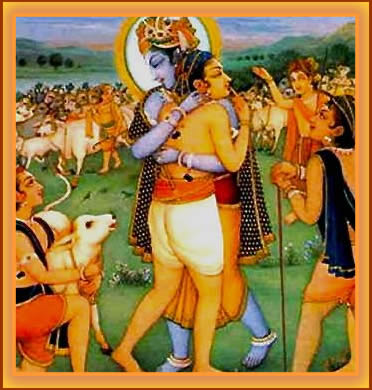
People believe that
incarnations of God happen only for two reasons: the
punishment of the wicked and the protection of the
righteous. But these represent only one aspect of
the task. The granting of peace and joy, of a sense
of fulfilment to seekers who have striven long -
this too is the task.
The avatâr, or
form incarnate, is only the concretisation of
the yearning of the seekers. It is the solidified
sweetness of the devotion of godly aspirants. The
formless assumes the form for the sake of these
aspirants and seekers. They are the prime cause. The cow secretes
milk for the sustenance of the calf. That is the
chief beneficiary. But, as we see, others too
benefit from that milk. So too, though the bhaktas
are the prime cause and their joy and sustenance the
prime purpose, other incidental benefits also
accrue, such as the fostering of religious
dutifulness (dharma), the suppression of evil
and the overwhelming of the wicked.
There is no compulsive
rule that incarnations should occur only on earth
and in human form. Any place, any form, can be
chosen by the fully-free. Whichever place, whatever
form, promotes the purpose of fulfilling the
yearning of the devotee, that place and that form
are chosen by the will of God. God is above and
beyond the limits of time and space. He is beyond
all characteristics and qualities; no list of such
can describe Him fully. For Him, all beings are
equal. The difference between man, beast, bird,
worm, insect and even a god is but a difference of
the 'vessel' (the upâdhi).
It is like the
electric current that flows through various
contrivances and expresses itself in many different
activities. There is no distinction in the current,
it is the same. To speak of it as different is to
reveal one's ignorance (a-jñâna). So too, the one single
God activates every vessel or upâdhi and gives rise to
manifold consequences. The wise see only the one
uniform current; the ignorant feel that they are all
distinct. God appreciates the consciousness of unity
as the basic motive of acts. He does not appreciate
the activity itself being one, without variety; it
is suited to the various needs. The fruits of karma
or activity appeal only to those who identify
themselves with the body and not for the others, who
know that they are the indestructible âtmâ.
Again, you must know
that there is no end to the incarnations that God
indulges in. He has come down on countless
occasions. Sometimes He comes with a part of His
glory, sometimes with a fuller equipment of
splendor, sometimes for a particular task, sometimes
to transform an entire era of time, an entire
continent of space.
It is the story of the
last of these, that the Bhâgavatam
elaborates. The drama enacted by the avatâra
and the bhaktas drawn towards Him, is the
subject matter of the Bhâgavatam. Listening
to it promotes the realisation of God. Many sages
have testified to its efficacy and extolled the Bhâgavatam,
which they helped preserve for posterity.
Generally speaking,
man gets drawn to sense objects, for he is the
victim of instincts. Instincts easily seek
sense-objects. They come along with the body and are
not derived by any training. The infant seeks milk
from the mother's breast; the new-born calf nestles
at the udder. No training is needed for this. But,
for the infant to walk and talk, some training is
necessary. The reason is that they are not
automatic; they are socially prompted, by example
and by imitation of others.
Training is essential
even for the proper pursuit of sense pleasure, for
it is the wild untrained search for such pleasure
that promotes anger, hatred, envy, malice, conceit.
To train them along salutary lines and to hold them
under control, certain good disciplines like
mantra meditation (japa), practice of
meditation (dhyâna), fasting (upavâsa), worship at dawn
and dusk (sandhya-vandana) etc. are
essential. But, however much their value may be
praised and their practice recommended, people do
not develop a taste for them. This is because the
desire for sensory pleasure has struck deep roots in
the human heart. When one is asked to do spiritually
salutary acts, one has no inner prompting at all.
Still one should not give up in despair. Until the
taste sprouts, the disciplines have to be strictly
followed. This taste is the result of training, no
one has it from the very beginning. Constant
practice will create the zest.
The infant does not
know the taste of milk. By taking it daily, it
develops an attachment for it which is so deep that
when milk is to be given up and rice substituted, it
starts to protest. But the mother does not despair;
she persuades the child to take small quantities of
cooked rice daily and by this process it starts
liking rice and it gives up milk. Milk was once its
natural food, so, natural that if no rice is
available for a single day, it becomes miserable.
So too, though
sense-pleasures are 'natural' at first by means of
practice and training and listening to the
commendation of the wise, slowly the greater and
more lasting pleasure derivable from the glories of
the Lord and their recapitulation is grasped.
Thereafter, one cannot exist without that atmosphere
even for a minute; one feels that there is nothing
as sweet as the experience of listening to the
splendor of the Lord. The company of the worldly who
chatter about the senses and the sense-objects will
no longer attract; the company which exults in
praising the Lord will draw and hold.
This is the real
hall-mark of the good. Sâdhakas and votaries
of the Lord are to be judged by these, not by
external apparel or appearances. If one mixes with
men who revel in sensory talks and activities, then,
he puts himself out of court. Spend your time in the
company of the godly, engaged in godly affairs.
Avoid getting mixed with the company of the ungodly.
Do not see their activities or listen to their
accounts. Only those who avoid them can be called bhagavatas,
God's own.
Reading and enjoying
the stories of the glory of Krishna in some
sacred spot or some temple or prayer-hall-shrine or
hermitage of a saint or sage, or in the company of
the virtuous and the good - that is a source of
great inspiration and joy. It makes people forget
everything else. Else, one can approach pious men
and serving them, listen to their exposition of the
glories of God. Taste for such wholesome literature
is the result of accumulated merit and endeavor. It
is that merit that rewards one with such company.
Listening will be enough in the beginning; later,
the stories will arouse interest in the nature and
characteristics of God and the aspirant will seek
and find for himself the path to realisation.
Listening to
expositions by the wise is much better than reading
oneself; or, one can be looking into the text while
listening. It is preferable to listen in company,
rather than alone; of course, it is excellent to
listen with a number of earnest aspirants. If the
person who expounds has had the thrill of genuine
experience, then it is the supremest luck, for it
yields best results. For, his face will blossom into
joy, his eyes will shed tears of joy at the very
contemplation of the glory of the Lord. Those who
listen to him will catch that inspiration; they will
experience the joy themselves. In the midst of a
group that weeps, tears will spring out of the eyes
of those who have come in. When an infant smiles,
those around will also smile in unison. So too, the
words of those who are saturated with devotion to
God will saturate the hearts of those who listen. It
is impossible to measure the profit that one can
derive while in the company of the great.
Through that process
of listening, a dirt-laden heart will be transformed
into a clean illumined heart, shining with genuine
light. To the foul odors of sense-pursuits, keenness
to listen to the glories of God is a valuable
disinfectant, besides being in itself so full of
sweet fragrance. The listening will cleanse the
heart through the prompting it gives for good work.
Such a cleansed heart
is the most appropriate altar or tabernacle. In that
fragrant bower, the Lord will establish Himself; at
that very moment, another incident too will happen.
The group of six vices - kâma: lust, krodha: anger,
lobha: possessiveness, mada: pride, mâtsarya: envy
and moha: delusion, (altogether called the anarthas) that had infested the
place will quit without so much as a farewell.
When these vices quit,
the wicked retinue of evil tendencies and vulgar
attitudes which live on them, will break camp and
disappear without leaving even their addresses!
Then, man will shine in his native splendor of truth
and love (satya and prema); he will
endeavor without hindrance to realise himself; and
finally, he will succeed in merging with the
universal and eternal. He will liberate himself from
the tangle of ignorance, or mâyâ. His mind
will fade away; the long-hidden secret will be
revealed to him; he will discover his mâdhava-tattva
(godliness, god-principle or divinity).
Man's nature is love
(prema). He cannot survive a moment, when
deprived of love. It is the very breath of his life.
When the six vices (anarthas), to which he was attached
so long, disappear, love is the only occupant of the
heart; but love has to find an object, a loved one.
It cannot be alone. So, it is directed to the
dark-blue divine child, the charming cowherd boy,
who is purity personified, who is the embodiment of
service, sacrifice and self-lessness, who has taken
residence in that cleansed altar. There is no scope
now for any other attachment to grow. So, step by
step, this Love for Mâdhava (name for Krishna as the
blooming hero, the sweet Lord) becomes deeper,
purer, more self-denying, until at last, there is no
other need for thought and the individual is merged
in the universal.
When Vâsudeva
enters the heart of man, vasudeva has no
longer a place therein. In other words, when the
deva of vasu or wealth is seated in
the heart, the divine Vâsudeva or Krishna
cannot dwell therein. Any attempt to accommodate both in the
heart is bound to fail. Darkness and light cannot
exist at the same time and in the same place; they
cannot continue together. Riches (dhanam) and
God (daivam) cannot be joint ideals; when dhanam
or riches is sought, daivam or God cannot
also be achieved. If both are sought by man, what he
will achieve will be neither dhanam nor daivam
but dayyam (the devil).
It is creditable if
man behaves as man; it is laudable if he behaves as
the Mâdhava, he really is. But, to behave as
a demon or as a beast is despicable indeed. For, man
was long born a mineral and died a mineral; then, he
promoted himself as a tree. He was long born a tree
and died as a tree; but, in the process, he got
promoted as an animal; but, he has now risen into
the status of man. This rise from one scale to
another has been acknowledged by science and
spiritual experience. Now, alas, he is born as man
and dies as man. It is a greater shame if he slides
into the beast or a beastly ogre. Praise is his due,
only if he rises to the divine status. That is real
fulfilment of his destiny. Therefore, avoid contact
with vices; develop attachment to virtues; transmute
the heart into an altar for the Lord; destroy all
the shoots and sprouts of desire; then, your
Manasa-sarovaram (the lake of your inner
consciousness) will be sublimated into a Ksheera-sagara,
(the pure ocean of milk, where the Lord reclines on
the serpent-couch). Your real self will,
like the celestial Hamsa, revel in the placid
waters of that lake, thus transformed. It will
discover endless delight.
Who can mark the
beginning of the continuous waves of the ocean? It
is an impossible task. If anyone decided to do so,
the wave with which he starts the calculation will
be considered as the beginning, the wave with which
he stops his calculation will be for him the last,
the end. There is a beginning and an end for his
count: there is no beginning or end for the process.
No one can visualise either, in that boundless
illimitable expanse. God's glory is the shoreless
ocean. When one starts describing it, it begins for
him; when he finishes his description it is the end,
so far as he is concerned. But, His glory is beyond
space and time. Only little minds, limited minds,
will argue that God's glory has a beginning and an
end. The stage on which He plays (His lîlâ) has no boundaries.
The story of the
Lord's adventures (lîlâs) is all nectar; it
has no other component, no other taste, no other
content. Every one can drink his fill, from any part
of that ocean of nectar. The same sweetness exists
everywhere, in every particle. There is nothing
inferior to mar the sweetness.
The love of God and
the love for God are both eternally sweet and pure,
whatever the method of your accepting or attaining
them. Such love is holy and inspiring. Sugar is
sweet when eaten during day or during the night. For
it is night or day for the person who eats, not for
the sugar. Sugar behaves uniformly always.

contents of this
Vahini | previous page |next
page
The painting on
this page is by Indra Sharma,
Nathdwara, in Rajasthan, India. Source.